
The Big Five at Work: Series Introduction

Background on Personality
Personality is our typical way of thinking, feeling, and acting. It is a critical part of what makes us who we are as individuals and has a significant impact on how we live our lives. In fact, it’s so powerful it has been shown to predict what most people would consider to be some of the most important outcomes imaginable in life: health, happiness, and longevity.
Personality also affects how we show up to work each day. Perhaps not surprisingly, then, it also predicts a countless number of outcomes that are of critical importance to organizations and individuals, including job performance, employee engagement, burnout, turnover, and leadership effectiveness, just to name a few.
Problems With Common Personality Measures
An important caveat to personality’s predictive power, however, concerns how organizations measure it. Unfortunately, the most common methods used in the workplace get it all wrong. The MBTI, DiSC, True Colors, and Enneagram err in two key ways.
First, they incorrectly treat personality as a categorical variable when it is actually a continuous one. Second, their conceptualization of personality is based on anecdotal rather than scientific evidence. For example, the MBTI (Myers-Briggs) was created by a mother and daughter who spent two decades “type watching.”
The Five-Factor Model of Personality
On the other hand, the most widely researched model of personality, known as “The Big Five” or the Five-Factor Model (FFM), was not discovered anecdotally, but through empirical methods using a statistical procedure called factor analysis. This technique, which identifies hidden relationships between variables and then groups them together based on similarities, identified five broad and continuous domains: Openness/Intellect, Agreeableness, Extraversion, Conscientiousness, and Emotional Steadiness.
Moreover, each of these domains is hierarchically structured and multi-faceted, consisting of two more specific aspects directly beneath the broader domain, and an even larger number of highly specific facets beneath those. And the most common and effective way to measure all of these traits is through a self-report personality survey that is based on The Big Five, adequately measures all of its facets, and administered and interpreted by an expert.
The Domains and Aspects are consistent throughout the literature. The specific facets under each Aspect are somewhat less consistent, so just 2 examples for each are shown in the below graphic.
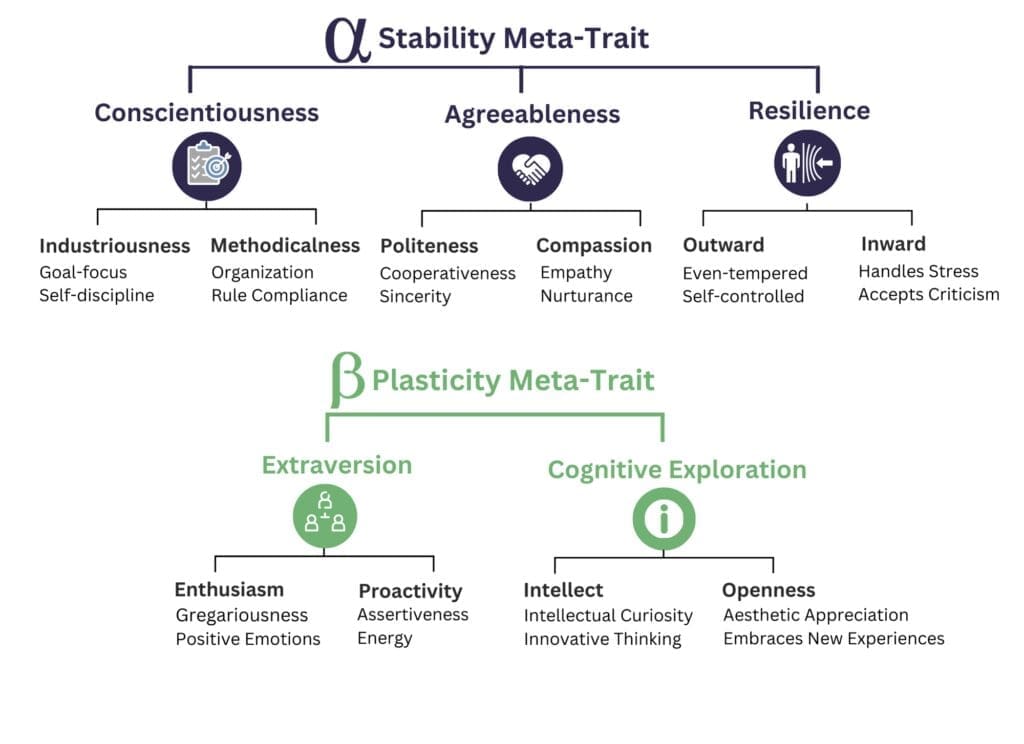
Learn more about the research behind the Five Factor Model in The Five Factor Model of Personality: A Research Brief.
The Big Five at Work: Series Introduction
In this series of 5 posts, we explain the science behind each domain and why it’s important to measure them properly when hiring people, developing leaders, and planning for succession. Access the series here: Conscientiousness, Emotional Steadiness, Agreeableness, Openness/Intellect, and Extraversion.
For the complete picture of how all five domains work together, read The Big Five at Work: Series Conclusion.

Keith Francoeur, Psy.D.